AI Will Gladly Think For You. It'll Make You Dumb.
Dec 11, 2025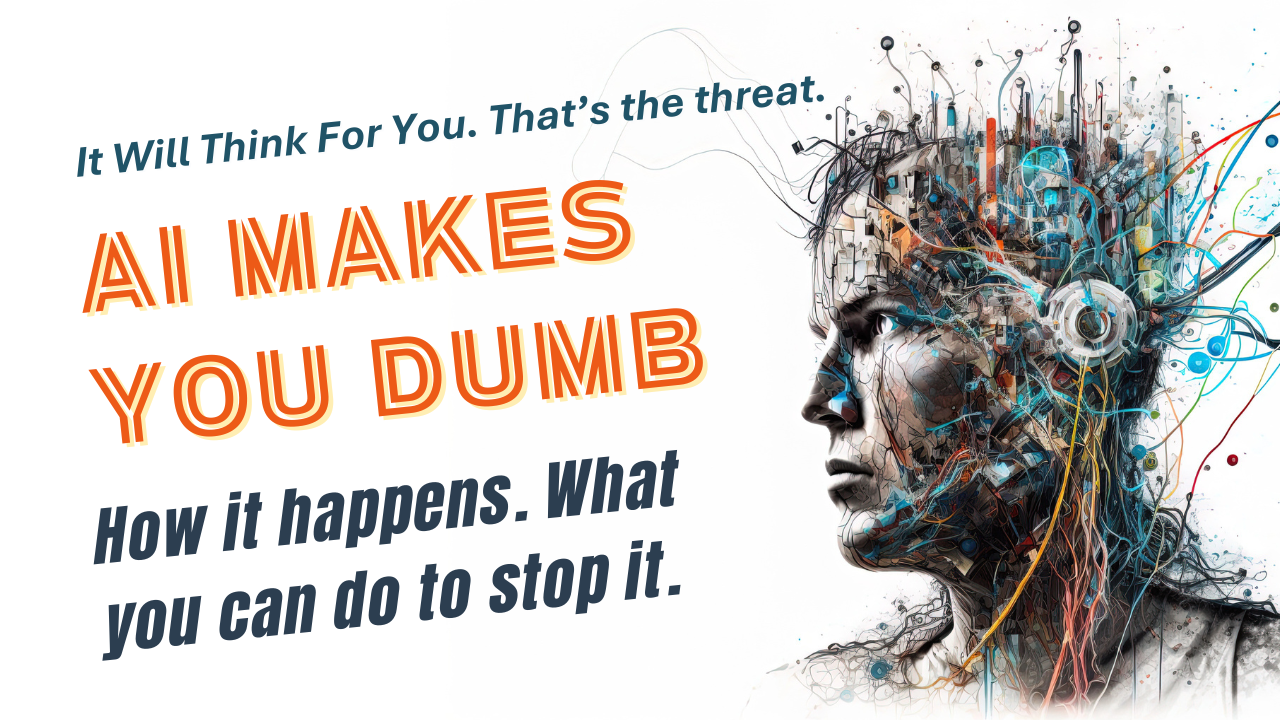
If you sell high-stakes advice, you are standing in a quiet war right now. On one side, you have AI, fast and tireless. It cleans data, drafts reports, and stitches together insights in minutes. On the other side, you have the only thing that earns your premium fee. Your judgment under pressure.
The danger is not that AI will replace you. The danger is that you will let it practice for you until your own knowledge evaporates and judgment goes soft.
A few months ago, it shocked me when it happened to me. I went on a sales call with a prospect who was so grateful for all the support I'd given her on LinkedIn. I couldn't even remember what I posted at all, like, that morning. Let alone how I interacted with her content last week.
That's when I realized I actually knew nothing of her work and background because AI had done most of the work for me commenting on her posts, respond to comments, and even sharing her content.
For one, I felt like a fake. Not a reputation, I'd like to have. Second, I realized how little I was learning about my market with such an approach. Less than ideal when you are a marketer. It is then an there I made the decision that this had to stop. Because AI should not empower and not dumbify. But it happens to AI-users as we speak.
Your Brain Runs On Effort. You Are Letting Software Spend It.
Think about your work as a mountain you climb for your clients. Some of that climb is the mountain itself. Some is the junk in your backpack. Some is the good strain that makes you stronger.
You can slice the load into three parts.
The first part is the hard problem you were hired to solve. Broken incentives. A stalled go-to-market. A leadership team that avoids decisions until the quarter is gone.
The second part is the junk weight. Dirty spreadsheets. Hunting for a missing slide. Wrestling with file formats. Hours of meeting notes that nobody will read.
The third part is the good struggle. The part of the work where your brain builds patterns that did not exist before. Connecting a founder’s regret from three years ago to the pricing mistake they are about to repeat. Seeing the political risk nobody is calling out.
You earn your fee in that third part.
The job of AI is simple. Kill the junk. Keep the climb. Grow the good strain.
When AI Owns The Junk, Your Leverage Compounds
Used well, AI is a friction killer, not a thinker.
You drop forty customer interviews into a model. It gives you clean transcripts and a first cut of themes. You do not need to be the person fixing the time stamps.
For all my Zoom calls, I use Krisp.ai. It not only improves the sound of my voice and kills all background noise. It also takes notes, records audio and video of Zoom calls if and when I want. It does so without actually having to be a meeting participant. It operates quietly in the background.
It helps me summarize calls and action items. I get transcript from training sessions I've delivered that can be easily cleaned up by chat GPT and then converted into drafts for LinkedIn Posts are supplemental study guides.
The I feed ten recordings of recent sales conversations into my ChatGPT. It compresses them into a one-page brief of the most common challenges my audience faces,. I do not need to be the person squinting at every paragraph in every transcript and putting snippets into a spreadsheet for further analysis.
I can ask GPT for a first pass of a LinkedIn post on the top three challenges my market faces =, so that I can tune it, sharpen it, and insert the political reality my client lives in.
When you delegate this layer, something powerful happens.
Your calendar stops bleeding with admin tasks. Your mind shows up fresh at the moments that matter. The late-night calls. The "do we shut this division down" meeting. The fragile conversation with the VP who might quit.
You are not saving time. You are buying back neural capacity.
That is the right use of AI.
When AI Owns The Thinking, Your Brain Starts To Forget How
Now the risk side.
If you let AI carry the good strain that trains your brain, you slide into a slow decline.
The model gives you a finished answer. Clean, plausible, nicely structured. You skim it, tweak a sentence, and ship. You feel efficient. You feel smart.
What did your mind not do?
You did not wrestle with the real structure of the problem. You did not generate competing hypotheses. You did not walk through the messy path from "what is going on" to "this is what we will do." The hard part of the work was bypassed rather than managed.
Back to my Krisp.ai example. I also feed transcriptions into GPT to look for unspoken thoughts, emotional triggers I may have missed, and detect patterns that are easy to miss. Then I used to ask it to develop new sales strategies, messaging, and campaigns for me. I stopped thinking these things through myself.
My brain missed the workout. No neural reps. No new patterns. No deeper understanding of why this answer fits that client in these moments. My messaging evolved, my brain didn't own it. Do this for a year, and your competitive sharpness erodes. You become an editor of AI output, not an originator of insight.
Eventually, you go on a Zoom call and have no idea about the difference AI has made for you. That's what happened on that infamous sales call. I just wasn't able to dial into my prospect's world as if I had carried all that cognitive load myself.
I learned that price shoppers will love it. They cannot tell the difference between my work and a cheaper generalist with the same tools. That is the test you never want to pass. I did.
Four Blind Spots That Quietly Kill Boutique Firms
Most firms will not feel the damage until it is late. The slide decks will still look pretty. The language will still sound sharp. The rot will sit one layer deeper.
The first blind spot is treating AI output as truth. As a fact sheet. The model is a statistical average of what has been said. Confidence is high. Contact with reality is low. Over time, your certainty rises while your field sense decays.
The second blind spot is cognitive atrophy. When you let the model do the hard wrestling, you stop seeing the pattern that nobody else sees. You forget how to build a case from scratch.
The third blind spot is homogenization. AI is a machine for the mean. Feed it the same prompts your competitors use, run it against the same data everybody else accesses, and your proposals converge. Smooth. Polished. Empty.
The fourth blind spot is losing the politics layer. AI assumes rational organizations. It does not see grudges, agendas, or pride. Ship its answer without tuning, and you hand your client a plan that dies as soon as it hits the room.
This is where boutique consultants either step up or slide into the commodity bin.
What The Crowd Will Do Next
Most consultants will react in a predictable way. You can already hear the language.
"AI will make your team faster."
"AI will free up time for strategy."
"AI will produce decks in minutes so you can focus on value."
They will ask their models for answers, not questions. They will sell "AI-powered" audits and "AI-enhanced" workshops. Their teams will start every project by asking the model, "What should we do?"
They will measure time saved instead of judgment strengthened. They will outsource the thinking and then look surprised when their offers sound like everyone else’s.
That is the crowd path. It feels efficient. It attracts price shoppers. You are not building your firm for price shoppers.
The Original Intelligence Path
Ai-First consultants do the opposite. They apply Original Intelligence. They define human-only reps. They treat those reps like non-negotiable training for their own brain. They run your first diagnosis by hand. They sketch the messy problem, list their own hypotheses, and name their own blind spots. Only then do they bring AI in as a hostile analyst.
Back to my Krisp example. This morning, I held a two-hour business strategy meeting with a client. After we finished, I put the entire transcript into ChatGPT and asked it to summarize the key points and extract the to-do list. It gave me 12. When I challenged ChatGPT that it had missed quite a few, it found the missing 21 ones.
It also missed the nuanced change in tone and face expression when she wasn't happy with the direction I took. I couldn't reconstruct the diagrams I drew on the whiteboard. It did not see where I made mistakes that I made in the moment and needed to correct in the follow-up. It did not point out any asymmetric advantage we could have created.
Hence, I took GPT's take and thought through where the biggest risks in our reasoning were and what pieces of data would kill my premise. And then I drafted prompts that can significantly enhance our work, simplify my client's follow up, and accelerate their to dos.
Original thinkers don't ask for a plan. They ask for attacks.
You design your offers the same way. You sketch the architecture yourself. Then you tell AI to generate variants, edge cases, and objections. You keep the frame. It brings the frictions.
You codify your lens. You give it a name. You tell the model, "Rewrite this through the lens of our own model and do not add any principle I have not defined." The AI becomes a style amplifier, not a philosophy vendor.
My favorite prompts are:
- "What would the crowd do next?’ Do the opposite to improve outcomes."
- "Would a price shopper love this? If yes, raise the bar. "
- "Could ten competitors post this tomorrow? If yes, rewrite"
- "Protect thinking time inside the answer."
- "Does this create an asymmetric advantage for a boutique firm? If not, find the unique advantage."
Then I apply my judgment as a filter. I throw out what I deem not useful. I keep what I believe is best. I learned that judgement comes from experience, which i turn includes failures. AI has never had that experience, hence it cannot judge.
Stop asking how AI can make you faster. You ask what it should take off your mind completely so you can think harder where it counts.
Protecting Judgment Time On Purpose
This is where thinking time becomes a business asset, not a luxury.
You block time to think with no model on. You run through a client’s situation with nothing but their materials. You force your own pattern sense to fire.
Then you use AI to stress test what you built.
How does this change your fee conversations? How do you sell when your client knows they can get a deck in 25 seconds?
You stop selling information. You start selling judgment under constraint.
You say, in plain words, that the model can see patterns and cannot weigh consequence. It can list options and cannot stand behind a choice when the room turns cold. You show how your process keeps human judgment in charge while AI handles the grind.
This is not a speech about ethics. It is a commercial argument. You are selling reduced regret. You are selling a better use of your client’s most expensive brains. You are selling a system that keeps them from outsourcing their own thinking to the cheapest average on the planet.
A Fifteen-Minute Drill For Serious Firms
Pick one live engagement. Not a case study. A real client on your calendar.
Map, in one page, where AI already touches the work. Lead research. Discovery notes. Diagnosis. Option design. Decks. Follow-up.
For each touch point, ask two questions:
- What is the risk of a blind spot if we let AI go one step further?
- What is the human-only question or check that would keep our brain firmly in charge.
Write one rule from each answer. Simple, testable, visible.
- "AI can summarize interviews. It cannot generate the problem statement."
- "AI can propose three options. It cannot choose the recommendation."
- "AI can draft the deck. It cannot decide the story arc."
Keep that page visible for a week. Adjust it after each client meeting. You are not writing a policy manual. You are training your own judgment.
Your Asymmetric Advantage In The AI Era
Clients can get cheap tools for analysis. They can buy reports, dashboards, and slide packs for a fraction of your fee.
Your competitive advantage is not in touching the tools first. It is in designing how tools and humans work together in one specific context with real stakes.
You frame the decisions that matter. You decide which ten percent of cases reach a human and in what state. You insist that your client’s senior people spend their limited neural energy on the calls that move money and risk.
That is not something ten competitors can copy tomorrow. It lives in how you think, how you protect your own brain, and how you refuse to outsource the hard parts.
In a market that worships speed, you become the person who protects judgment.
AI will gladly think for your firm. The real question is different.
How fast do you want to trade away the one thing your best clients still cannot buy anywhere else?
Measure how original your offer really is with The Original Intelligence GPT.
About Andrew Lawless
Andrew Lawless helps boutique consulting firm owners use AI without giving away the one asset they cannot replace. Their judgment under pressure. He is the founder of High Performance Business Academy and an AI-first growth strategist for consultants who sell high-stakes advice and premium outcomes.
For more than two decades, Andrew has coached leaders at the FBI, Special Forces, the World Bank, and Fortune 500 companies. His work focuses on one thing. Protecting thinking time for the people whose decisions move money and risk. He shows experts how to let AI clear the junk work, sharpen their own models of reality, and keep human judgment in charge when the room turns cold.
Andrew writes, teaches, and builds systems that treat AI as a hostile analyst rather than a replacement brain. Consultants come to him when they are tired of generic “AI-powered” promises and want a concrete way to design offers, sales systems, and delivery that keep Original Intelligence on the hook for the hard calls.